
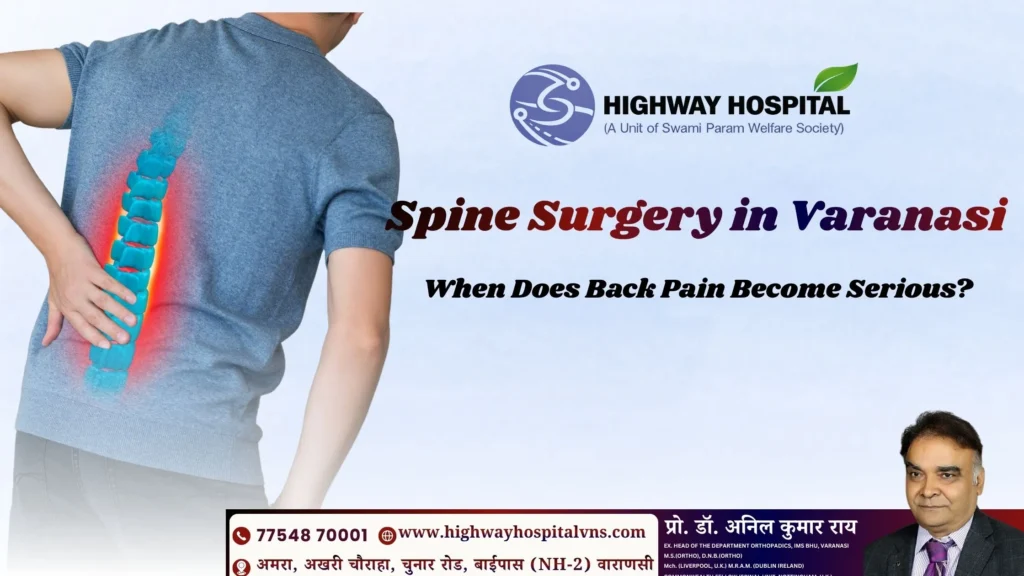
Spine Surgery in Varanasi — When Does Back Pain Become Serious?
Most back pain does not require surgery. The majority of cases resolve with rest, physiotherapy, and appropriate medication. However, certain symptoms — persistent or worsening pain, pain radiating into the legs or arms, weakness or numbness in the limbs, or loss of bladder or bowel control — indicate a more serious spinal problem requiring medical evaluation and, in selected cases, surgical intervention.
Introduction
Back pain is one of the most common health complaints in India, affecting people across all age groups — from office workers sitting for long hours to farmers doing heavy labour, from young adults with poor posture to older patients with degenerative spinal conditions.
In Varanasi and the surrounding districts of Eastern Uttar Pradesh, a significant number of patients arrive at orthopedic clinics months or even years after their symptoms first began. Many have managed with painkillers and home remedies. Some have significantly reduced their daily activity to avoid triggering pain. A few arrive with symptoms that have progressed to the point where they are affecting the nerves — causing weakness, numbness, or loss of bladder control.
The question this article addresses honestly is: when does back pain cross the line from a common, self-limiting problem to something that requires specialist assessment — and potentially spine surgery in Varanasi or elsewhere?
The answer is not that every back pain needs a surgeon. The vast majority does not. But some conditions do — and knowing the difference matters.
Most Back Pain Is Not a Spine Emergency
This is the most important thing to establish clearly: back pain is common, and most of it is not serious.
The World Health Organization notes that low back pain is the leading cause of disability worldwide — affecting approximately 619 million people globally. The majority of these cases are mechanical in origin, meaning they relate to muscles, ligaments, and joints responding to strain, poor posture, or overuse. They are painful and disruptive, but they are not structural emergencies.
Mechanical back pain typically:
- Develops after a specific activity, awkward movement, or prolonged poor posture
- Improves with rest, gentle movement, and over time
- Does not cause weakness or numbness in the limbs
- Does not affect bladder or bowel function
- Responds to physiotherapy, anti-inflammatory medication, and lifestyle changes
When back pain fits this pattern, the first line of management is conservative. Surgery is not indicated, and it would not help.
When Back Pain Becomes a Reason to See a Spine Specialist
There are symptoms that change the picture. These are not necessarily surgical emergencies in themselves, but they indicate that a proper clinical assessment — with appropriate imaging — is needed before continuing to manage the pain conservatively.
Pain That Radiates Down the Leg or Arm
When back pain travels down the leg — particularly below the knee — it often means a spinal nerve is being compressed. This pattern is commonly associated with a slipped disc (herniated disc) pressing on a nerve root. The same can occur in the neck, with pain or tingling radiating down the arm.
Sciatica, one of the most commonly discussed nerve pain syndromes, is not a diagnosis in itself — it is a symptom pattern describing pain along the path of the sciatic nerve. The underlying cause needs to be identified. Not all cases of sciatica require surgery, but a specialist assessment is needed to determine the appropriate management.
Weakness, Numbness, or Tingling in the Limbs
When nerve compression progresses beyond pain to cause actual weakness — difficulty lifting the foot, weakness in gripping, or a feeling that a limb is not responding normally — this is a significant warning sign. Numbness and persistent tingling that does not resolve with position change also warrants urgent evaluation.
These symptoms suggest the nerve is being significantly compressed and may be at risk of damage if the underlying problem is not addressed.
Pain That Does Not Improve After 6–8 Weeks of Conservative Treatment
Most mechanical back pain improves meaningfully within six to eight weeks of appropriate conservative management. Pain that is not improving — or that is getting worse despite rest and treatment — should prompt specialist review to rule out structural causes that conservative management alone cannot address.
Pain Following a Trauma or Fall
Back pain that begins after a fall, a road accident, or any significant impact should be assessed promptly. Fractures of the vertebrae — particularly in older patients with reduced bone density — can occur with surprisingly minor trauma. These require imaging to rule out structural damage.
For patients who experience a traumatic injury with back pain, 24×7 emergency and trauma care should be sought immediately.
Loss of Bladder or Bowel Control
This is a genuine medical emergency. When spinal nerve compression affects the nerves controlling the bladder or bowel — a condition called cauda equina syndrome — it requires emergency surgical evaluation. Loss of control, difficulty urinating, or saddle numbness (numbness in the area that would contact a saddle) alongside back pain should prompt immediate hospital attendance. Do not wait.
Severe Spinal Deformity or Progressive Change in Posture
Significant curvature of the spine (scoliosis or kyphosis) that is worsening, or a noticeable change in posture or height, particularly in older patients, can indicate structural spinal changes that require specialist review.
Common Spinal Conditions That May Require Specialist Care
Understanding the underlying diagnosis helps patients understand why treatment recommendations differ from case to case.
Herniated Disc (Slipped Disc): The soft tissue inside a spinal disc pushes through its outer wall and presses on a nearby nerve root. Most cases respond to conservative management. Surgery is considered when nerve symptoms are severe, progressive, or persistent despite adequate non-surgical treatment.
Spinal Stenosis: Narrowing of the spinal canal — most commonly from degenerative changes — reduces the space available for the spinal cord and nerves. Symptoms typically include leg pain and weakness that worsens with walking and improves with rest. Surgery may be considered for patients with significant functional limitation.
Spondylolisthesis: One vertebra slips forward over another, which can cause pain, nerve compression, and instability. Surgical stabilisation is considered in patients with nerve symptoms or significant instability.
Vertebral Fractures: Compression fractures of the vertebrae, often related to osteoporosis, can cause sudden severe back pain and postural change. Treatment depends on the fracture type and severity.
Degenerative Disc Disease: Progressive wear of the intervertebral discs over time, which can cause chronic pain and reduced spinal flexibility. Management is predominantly conservative in most patients.
How Is a Spine Problem Diagnosed?
Arriving at the right diagnosis requires a structured clinical assessment — not simply an MRI scan.
The diagnostic process at Highway Hospital’s Orthopedic Department typically follows this sequence:
- Detailed clinical history — symptom duration, character, radiation pattern, aggravating and relieving factors
- Physical and neurological examination — reflexes, muscle strength, sensory testing, and range of movement
- Imaging where clinically indicated — X-rays for bone alignment and fractures; MRI for soft tissue, disc, and nerve assessment; CT scan in selected cases
- Correlation of clinical findings with imaging — this step is critical, because imaging findings alone do not determine whether surgery is needed. A disc abnormality visible on MRI does not automatically mean it is causing the patient’s symptoms
Experienced orthopedic specialists and surgeons at Highway Hospital take this evidence-based approach to ensure that treatment — whether surgical or non-surgical — is matched to the actual clinical picture.
Non-Surgical Treatment for Spine Problems
The majority of spine conditions, including many that have a structural component, are managed non-operatively in the first instance. Options include:
- Physiotherapy and structured rehabilitation — targeted exercises to strengthen the muscles supporting the spine, improve posture, and reduce nerve irritation. This is the most important non-surgical intervention for most spinal conditions.
- Pain management — anti-inflammatory medications, muscle relaxants, and nerve pain medications prescribed by a doctor based on the specific diagnosis
- Epidural steroid injections — in selected patients with nerve root compression, injections can reduce inflammation around the nerve and provide meaningful pain relief
- Activity modification and postural correction — particularly for patients with mechanical back pain related to occupational or lifestyle factors
As the Indian Orthopaedic Association advises in its clinical guidelines, conservative management is the appropriate first line for most spinal conditions, with surgery reserved for those who do not respond adequately or who present with progressive neurological compromise.
When Is Spine Surgery Actually Considered?
Surgery is a clinical decision — made individually, based on a specific patient’s diagnosis, symptom severity, response to conservative treatment, and overall health status. It is never a routine recommendation for back pain.
Spine surgery may be considered when:
- A structurally confirmed problem is directly causing nerve compression or instability
- The patient has significant or progressive neurological symptoms (weakness, numbness, loss of function)
- Adequate conservative management over an appropriate period has not provided sufficient relief
- Quality of life is significantly affected and the patient is medically suitable for surgery
- Cauda equina syndrome or other emergency situations are present
The goal of spine surgery is not simply to relieve pain — it is to address the structural cause of nerve compression or instability, allowing the nervous system to recover and function to return. Recovery takes time, and post-surgical rehabilitation is an integral part of the outcome.
For patients wondering about the broader context of orthopedic surgery in Varanasi — covering fractures, joint replacement, and trauma alongside spine care — the Highway Hospital orthopedic surgery overview provides additional background.
Spine and Orthopedic Care at Highway Hospital, Varanasi
Highway Hospital on NH-2 provides orthopedic assessment and surgical care for patients with spine and musculoskeletal conditions. The hospital is accessible from Varanasi city and from surrounding districts including Chandauli, Jaunpur, and Mirzapur.
Services relevant to patients with spine and back problems include:
✔ Orthopedic and spine consultation with structured clinical assessment
✔ On-site MRI, CT scan, and X-ray — available 24×7
✔ Non-surgical management including physiotherapy support
✔ Surgical facilities — modern operation theatres with laminar airflow
✔ ICU and critical care for post-operative monitoring
✔ Emergency and trauma services — round the clock
✔ Ayushman Bharat accepted — eligible patients can access care under PM-JAY
✔ CGHS and ECHS empanelled
See the full facilities overview at Highway Hospital for complete details of available infrastructure.
Conclusion
Back pain is common, and most of it does not require surgery. But certain symptoms — radiating pain into the legs or arms, weakness or numbness in the limbs, pain following trauma, and loss of bladder or bowel control — indicate a more serious spinal problem that needs proper medical evaluation.
The appropriate response to these symptoms is a structured clinical assessment: detailed history, thorough examination, and targeted imaging where indicated. Treatment — whether conservative physiotherapy, medication, or surgical intervention — should follow from the diagnosis, not precede it.
If your back pain has been persistent, is worsening, or is accompanied by any neurological symptoms, do not continue self-managing without a specialist assessment.
Book a Spine Consultation at Highway Hospital, Varanasi
Agar back pain kaafi time se hai, ya pair mein dard/numbness aa raha hai — toh expert se milna zaroori hai.
Consult an experienced orthopedic specialist at Highway Hospital for accurate diagnosis and a treatment plan matched to your condition.
📞 Call / WhatsApp:
+91 7754870001 | +91 8299004826 | +91 9455004097
📍 Highway Hospital
Amara Akhari Chauraha, Chunar Road, Bypass NH-2, Varanasi, UP
🌐 Website: highwayhospitalvns.com
📘 Facebook: facebook.com/highwayhospitalvaranasi
📸 Instagram: instagram.com/highway.hospital
📍 Google Maps: Get Directions
⏰ Emergency Care: 24×7 Available
FAQ’s
Q1. Does back pain always mean I need spine surgery?
No. The majority of back pain cases are mechanical in origin and resolve with physiotherapy, appropriate medication, and lifestyle changes. Surgery is considered only for specific diagnosed conditions — such as a herniated disc causing progressive nerve symptoms or spinal instability — and only when conservative management has not provided adequate relief.
Q2. What are the warning signs that back pain is serious?
Seek specialist evaluation if you have back pain accompanied by pain radiating below the knee, weakness or numbness in the legs or arms, pain following an injury or fall, or any difficulty with bladder or bowel control. These symptoms suggest nerve involvement and require proper clinical assessment and imaging rather than continued home management.
Q3. What is sciatica and does it need surgery?
Sciatica describes pain radiating along the path of the sciatic nerve — typically from the lower back, through the buttock, and down the leg. It is usually caused by a compressed nerve root, most commonly from a herniated disc. Most cases respond to non-surgical management. Surgery is considered only when symptoms are severe, progressive, or persistent despite adequate conservative treatment.
Q4. How long should I try conservative treatment before considering surgery?
There is no fixed timeline, but most spine specialists allow six to twelve weeks of structured conservative management — including physiotherapy and appropriate medication — before reassessing. If symptoms are worsening rapidly, if neurological function is deteriorating, or if a medical emergency exists, earlier surgical assessment may be needed. This decision should be made with a spine specialist.
Q5. What does spine surgery involve and how long is recovery?
The type of surgery depends on the underlying diagnosis. Common procedures include discectomy (removing the herniated portion of a disc), laminectomy (creating more space for compressed nerves), and spinal fusion (stabilising two or more vertebrae). Recovery varies by procedure — from a few weeks for minor procedures to several months for fusion surgery — and requires structured post-operative physiotherapy.
Q6. Where can I get spine assessment and treatment in Varanasi?
Highway Hospital on NH-2, Varanasi provides orthopedic consultation, on-site MRI and imaging, non-surgical spine management, and surgical facilities for appropriate cases. The hospital is accessible from Varanasi and surrounding areas, including Chandauli, Jaunpur, and Mirzapur. Call +91 7754870001 for appointments or emergency assistance.