
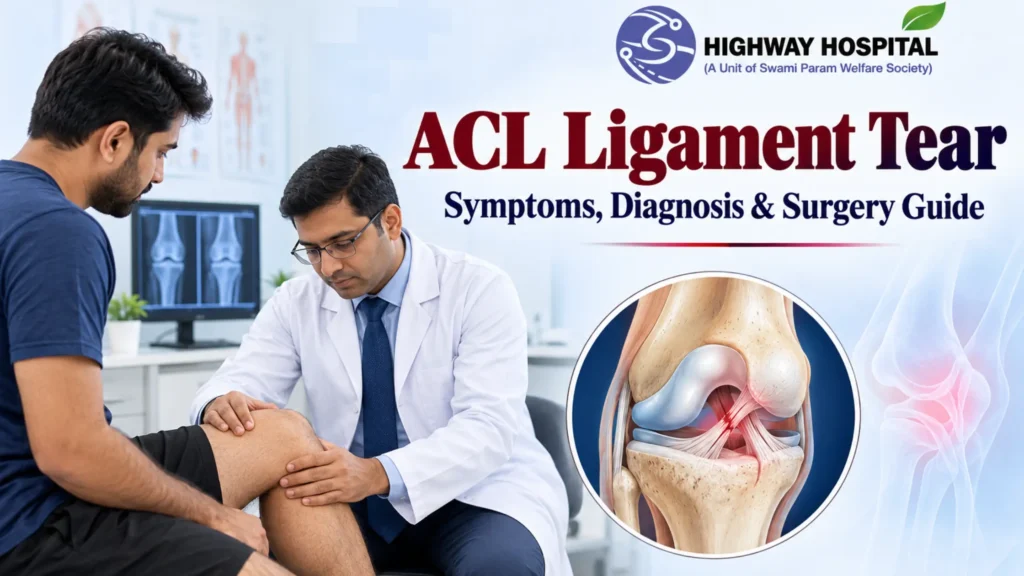
ACL Ligament Tear: Symptoms, Diagnosis & Surgery Guide — Highway Hospital, Varanasi
An ACL tear is a rupture of the anterior cruciate ligament inside the knee — one of the most common serious knee injuries, particularly in active individuals. Symptoms include a sudden popping sensation, rapid swelling, and knee instability. Not every ACL tear requires surgery. Treatment depends on injury severity, lifestyle, age, and individual clinical assessment by an orthopaedic specialist.
The knee is one of the most mechanically complex joints in the body. It depends on a network of ligaments, tendons, and cartilage to remain stable through the demands of everyday movement — walking, climbing stairs, changing direction, and absorbing impact. When one of those structures fails suddenly, the consequences can be immediate and significant.
The ACL — the anterior cruciate ligament — is the most frequently injured ligament in the knee. For active individuals in Varanasi and across Eastern Uttar Pradesh, an ACL tear is a serious knee injury that needs proper assessment. But it is not a condition that automatically leads to the operating table.
This guide explains what the ACL does, how it gets injured, how the diagnosis is made, and what treatment options are available — including when ACL surgery in Varanasi may genuinely be the right decision, and when it may not be.
What the ACL Does — and Why It Matters
The anterior cruciate ligament is a strong, rope-like band of tissue running diagonally through the centre of the knee joint — connecting the lower end of the femur (thighbone) to the upper end of the tibia (shinbone). Its primary job is to prevent the tibia from sliding forward relative to the femur, and to provide rotational stability to the knee.
According to the American Academy of Orthopaedic Surgeons, the ACL is one of the four major ligaments of the knee. When it is torn, the knee loses a significant element of its stability — which is why an ACL injury often causes the knee to feel like it is “giving way” during activity.
How ACL Tears Happen
The majority of ACL tears occur without any direct contact. They typically result from:
- Sudden changes of direction during sport — pivoting, cutting, or sidestepping
- Sudden deceleration while running
- Landing awkwardly from a jump with the knee in a vulnerable position
- Direct impact to the knee from another player or object (less common)
Cricket, football, kabaddi, running, and gym training all carry ACL injury risk. But ACL tears can also occur in non-sporting situations — a misstep on stairs, a fall on uneven ground, or any moment where the knee is forced into an uncontrolled rotation under load.
Adolescents, young adults, and women tend to be at relatively higher risk during sports, though ACL injuries affect patients across all age groups.
Symptoms — What an ACL Tear Feels Like
Not every knee injury is an ACL tear, and not every ACL tear feels the same. But certain symptoms are strongly associated with this type of injury:
At the moment of injury:
- A sudden, loud “pop” or crack felt or heard inside the knee
- Immediate pain — though some patients describe the pain reducing quickly after the initial moment
- Rapid swelling developing within one to two hours (caused by bleeding inside the joint — haemarthrosis)
- A feeling that the knee “gave out” or “buckled”
In the hours and days following:
- Persistent swelling and tenderness around the knee
- Difficulty bearing weight fully on the affected leg
- Limited range of motion — difficulty fully bending or straightening the knee
- A sense that the knee is unstable or unreliable, particularly when changing direction
Important warning: If you are unable to bear weight at all, if the knee appears visibly deformed, or if circulation to the lower leg seems affected — indicated by a cold, pale, or numb foot — seek emergency assessment immediately. These signs require urgent medical attention and should not wait for a routine appointment.
How an ACL Tear Is Diagnosed
A clinical assessment by an experienced orthopaedic specialist is the foundation of an accurate ACL diagnosis. Imaging alone is not sufficient — and an MRI abnormality does not automatically confirm that it is causing your specific symptoms or determining your treatment.
Clinical examination involves specific physical tests that assess the stability of the ACL under controlled conditions. The Lachman test and the anterior drawer test are the most commonly used. An experienced examiner can often identify an ACL rupture with a high degree of confidence from clinical examination alone, even before imaging.
Imaging is used to confirm the clinical suspicion, assess the degree of injury, and identify associated injuries — which are common with ACL tears. The meniscus (cartilage cushion inside the knee), the collateral ligaments, and the articular cartilage surface can all be injured at the same time as the ACL.
- X-rays are typically taken first to rule out bone fractures.
- MRI is the primary imaging tool for soft tissue assessment. It shows the ACL directly and helps identify meniscal tears, bone bruising, and other associated injuries that will influence treatment planning.
At Highway Hospital’s Orthopaedic Department, on-site MRI, CT scan, and X-ray are available 24×7 — allowing complete diagnostic assessment without the need to visit separate facilities.
Does Every ACL Tear Require Surgery?
This is the most important question — and the honest answer is no.
Not every ACL tear requires surgical reconstruction. Treatment decisions depend on multiple factors that are specific to the individual patient:
Non-surgical management may be appropriate for:
- Patients with partial ACL tears who have minimal instability
- Less active patients and older adults whose functional demands do not require the rotational stability that the ACL provides
- Patients whose knee is otherwise stable with the help of the surrounding muscles and other ligaments
- Some patients who are willing to modify their activity level and commit to a structured rehabilitation programme
Non-surgical management involves a period of initial rest and swelling reduction, followed by structured physiotherapy focused on restoring strength, proprioception (the knee’s positional awareness), and functional stability. The goal is to allow the individual to return to their desired activities with a stable, functional knee.
It is important to understand that the ACL itself does not heal — once torn, the tissue does not spontaneously repair in the same way a muscle might. However, some patients with ACL tears can function well without ligament reconstruction, particularly with strong surrounding musculature and appropriate activity modification.
When ACL Surgery Is Considered — and What It Involves
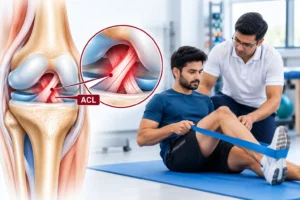
ACL reconstruction may be considered in selected patients, based on a clinical evaluation by an orthopaedic specialist. It is typically discussed when:
- The patient is young and active, with sporting goals that require rotational knee stability
- The knee remains functionally unstable despite adequate rehabilitation
- There are associated injuries — such as a significant meniscal tear — that also require surgical treatment
- The patient’s quality of life or occupation is significantly affected by the instability
The procedure itself — ACL reconstruction — involves replacing the torn ligament with a tendon graft. The graft is most commonly taken from the patient’s own body (autograft): the patellar tendon (the tendon below the kneecap) or one of the hamstring tendons are the most frequently used donor sites. The surgery is typically performed arthroscopically — using small incisions and a camera — which reduces trauma to the surrounding tissues compared to open surgery.
For patients in Varanasi who are candidates for surgery, the arthroscopy and sports injury services at Highway Hospital include ligament reconstruction and arthroscopic knee surgery, performed by the orthopaedic team.
Like all surgical procedures, ACL reconstruction carries risks. These include the general risks of surgery and anaesthesia, risk of infection, graft failure, stiffness, and the possibility that the knee does not return to its pre-injury level of function. These risks should be discussed fully with your surgeon before any decision is made.
Recovery and Rehabilitation — Realistic Expectations
Recovery from an ACL tear — whether managed surgically or non-surgically — requires commitment to structured rehabilitation. This is not optional. The quality and consistency of rehabilitation is one of the strongest predictors of long-term outcome.
General rehabilitation milestones (for surgical patients) typically follow a staged progression:
- Weeks 1–2: Swelling control, early range of motion, weight-bearing as tolerated
- Weeks 3–6: Strengthening exercises begin, gait normalisation
- Weeks 6–12: Progressive strengthening, balance and coordination training
- Months 3–6: Sport-specific functional training — depending on the patient’s goals
- Return to sport: Typically considered from six months onwards, but this decision depends on objective criteria — strength symmetry between both legs, functional test performance, psychological readiness, and clinical assessment — rather than a fixed calendar date
Return to unrestricted sport should not be based on time alone. A knee that appears healed externally may not yet have the internal graft maturation and neuromuscular readiness to withstand high-demand activity safely.
For patients with knee pain who are working on prevention and rehabilitation exercises, the joint health and exercise guide from Highway Hospital provides evidence-based guidance on strengthening the muscles that support the knee.
ACL and Sports Injury Care at Highway Hospital, Varanasi
Highway Hospital on NH-2, Varanasi provides orthopaedic assessment and treatment for ACL injuries and sports-related knee conditions. The hospital serves patients from Varanasi, Chandauli, Jaunpur, Mirzapur, and surrounding districts of Eastern Uttar Pradesh and Bihar.
Services relevant to patients with ACL injuries include:
✔ Orthopaedic consultation — clinical assessment by experienced surgeons including Prof. Dr. A.K. Rai (MS Ortho, Ex-HoD IMS BHU) and Dr. Satyaprakash Modanwal (MS Ortho, IMS BHU)
✔ On-site MRI, X-ray, and CT — available 24×7 for complete diagnostic assessment
✔ Arthroscopic knee surgery — ligament reconstruction and meniscal procedures
✔ Structured physiotherapy and rehabilitation — from initial injury through to return to sport
✔ 24×7 emergency orthopaedic care — for acute injuries on NH-2 and surrounding areas
✔ Ayushman Bharat (PM-JAY) accepted — eligible patients can access orthopaedic care cashlessly
✔ CGHS and ECHS empanelled — major TPA and insurance partners accepted
See the hospital facilities overview for full details of diagnostic and surgical infrastructure.
Conclusion
An ACL tear is a significant knee injury — but it is not an automatic sentence to surgery, and it is not a condition that should be self-managed without proper assessment. The right treatment depends on the specific injury, the patient’s age, activity goals, associated injuries, and the findings of a thorough clinical evaluation.
If you have sustained a knee injury — particularly one involving a sudden pop, rapid swelling, or a feeling of instability — a specialist assessment is the appropriate next step. Early evaluation allows more treatment options to be considered, and accurate diagnosis prevents the long-term problems that arise from an undiagnosed or mismanaged ACL injury.
Book an Orthopaedic Assessment at Highway Hospital, Varanasi
Knee injury? Instability? Don’t delay — get a proper assessment first.
Hamare orthopaedic specialists se milein — Varanasi ke NH-2 par, 24×7.
📞 Call / WhatsApp:
+91 7754870001 | +91 8299004826 | +91 9455004097
📍 Highway Hospital
Amara Akhari Chauraha, Chunar Road, Bypass NH-2, Varanasi, UP
🌐 highwayhospitalvns.com
📍 Get Directions on Google Maps
📘 Facebook
📸 Instagram
⏰ Emergency Orthopaedic Care: 24×7
FAQs
Q1. Can an ACL tear heal on its own without surgery?
The ACL does not repair itself once torn — the tissue does not heal the way a muscle or bone does. However, some patients with ACL tears can function well without surgery, particularly less active patients or those with partial tears and a stable knee. A clinical assessment is needed to determine whether surgery is appropriate for your situation.
Q2. What is the difference between a partial and a complete ACL tear?
A partial tear means some fibres of the ACL remain intact, which may allow greater residual stability. A complete tear means the ligament has ruptured fully. Both types require proper assessment — the presence of associated injuries, the degree of knee instability, and the patient’s activity level all influence whether surgery is recommended.
Q3. How is an ACL tear diagnosed?
Diagnosis involves a clinical examination by an orthopaedic specialist — using specific physical tests to assess knee stability — followed by MRI to confirm the injury and identify any associated damage to the meniscus, cartilage, or other ligaments. X-rays are also taken to rule out fractures. Clinical findings and imaging together guide treatment decisions.
Q4. How long does ACL surgery recovery take?
Return to everyday activities typically begins within a few weeks of ACL reconstruction. Return to unrestricted sport is usually considered from six months onwards, depending on rehabilitation progress, strength restoration, and objective functional assessments. Individual recovery timelines vary. A fixed calendar date is not a sufficient basis for return to sport — clinical readiness matters more.
Q5. Is ACL surgery safe, and what are the risks?
ACL reconstruction is a commonly performed orthopaedic procedure with generally good outcomes in appropriate candidates. Like all surgery, it carries risks including infection, anaesthetic complications, graft failure, stiffness, and the possibility that the knee does not return fully to pre-injury function. Your surgeon should discuss all relevant risks and realistic outcomes with you before any surgical decision is made.
Q6. Where can I get ACL assessment and treatment in Varanasi?
Highway Hospital on NH-2, Varanasi offers orthopaedic consultation, on-site MRI and diagnostic imaging, arthroscopic surgery, and structured rehabilitation for ACL and sports knee injuries. The hospital serves Varanasi and surrounding areas including Chandauli, Jaunpur, and Mirzapur. Call +91 7754870001 for an appointment or emergency assistance.